
Millom Footprints
For many years, locals in Millom have been aware of footprints in the clay near Millom Mains but it was only in 2017 that local historian, Duane Farren, identified them as ancient footprints.
 Duane notes in his diary, 6th January, 2017: Animal footprints - finding animal bones along the Mains shoreline.
Could they be old? 7th January: More animal bones turning up. Also many animal footprints are starting to show
up on the Duddon foreshore.
Duane notes in his diary, 6th January, 2017: Animal footprints - finding animal bones along the Mains shoreline.
Could they be old? 7th January: More animal bones turning up. Also many animal footprints are starting to show
up on the Duddon foreshore. After seeking advice from archaeologists it was confirmed Duane had discovered ancient tracks that offered insights into Millom's prehistoric inhabitants going back to the mesolithic period.
From that moment on, Duane began to visit Millom Mains regularly to monitor and keep a photographic record of the numerous human and animal footprints that turned up after high tides and storms. He regularly took groups of people down to the Mains to show them the footprints. He did this until his untimely death in March 2025.
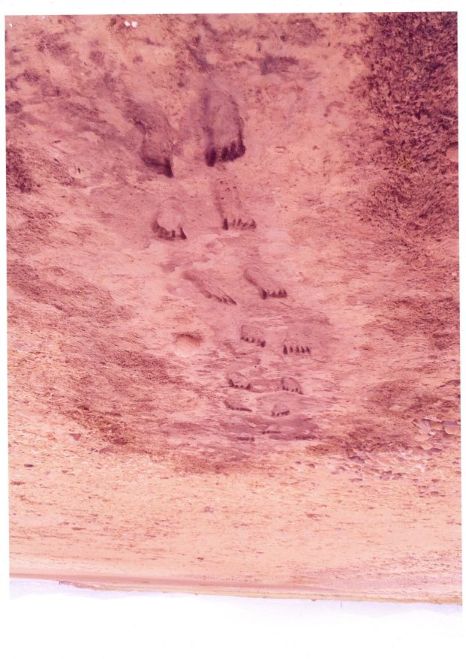 The clay layers found on the shoreline around the Duddon Estuary would once have looked very different. The sea
level would have been lower and the whole area would have been a mix of peat bogs, estuarine silts, reedbeds and
woodland. A perfect environment for prehistoric people to find food and other resources but it was also perfect
for preserving their footprints and those of the animals they hunted.
The clay layers found on the shoreline around the Duddon Estuary would once have looked very different. The sea
level would have been lower and the whole area would have been a mix of peat bogs, estuarine silts, reedbeds and
woodland. A perfect environment for prehistoric people to find food and other resources but it was also perfect
for preserving their footprints and those of the animals they hunted.
 People and animals walked through the soft wet silts of the floodplain leaving footprints. These then had time to dry
and harden before a new layer of mud was deposited. The layers built up over time protecting the footprints until
recent coastal erosion washed the covering away.
People and animals walked through the soft wet silts of the floodplain leaving footprints. These then had time to dry
and harden before a new layer of mud was deposited. The layers built up over time protecting the footprints until
recent coastal erosion washed the covering away.
 These features are exposed through tidal processes and storms, sometimes only for a matter of hours before the next
tide removes all evidence that they were there. Duane's photographic records are, therefore, crucial in providing
evidence of the inhabitants of Millom from ancient times.
These features are exposed through tidal processes and storms, sometimes only for a matter of hours before the next
tide removes all evidence that they were there. Duane's photographic records are, therefore, crucial in providing
evidence of the inhabitants of Millom from ancient times. Duane took hundreds of photographs of the human footprints as well as animal footprints including aurochs - a huge cow that became extinct in Britain in the Bronze Age - wild boar, red deer, roe deer, wolf and beaver.
Millom and District Local History Society were originally loaned around 170 prints which we scanned and put up here:
BUT...
It gets better. His wife, Sharon, managed to find two memory sticks with much, much, better quality photographs and many more. These have now been analysed and sorted into files. They cover 2017 (none for July and December) and January, March, May and June 2018. It seems highly likely there were many more but unfortunately, at this point in time, these have not surfaced. Here are the ones that have:
PLEASE: DO NOT WALK ON THE MUD FLATS OR LET YOUR DOG WALK ON THEM AS THIS COULD SERIOUSLY DAMAGE ANY EVIDENCE THERE IS. THANK YOU.
NEXT STEPS
We have now published a book, The Prehistoric Footprints of Millom: dedicated to Duane Farren. It is available from Millom Heritage and Arts Centre, Frame-It and Holy Trinity Church, Millom as well as Greenlane Archaeology and Sutton's Bookshop, Ulverston, price £10. The proceeds go to the History Society to help towards further research.
Duane also collected lots of twine he found near the footprints and always wanted some to be radiocarbon dated. The History Society arranged to have one strand radiocarbon dated (it cost £1,350 for this as other procedures were needed, such as removing tar). Disappointingly, the date which came back was 19th, early 20th century. But this was only one strand and there were bits of hazel nuts as well. However, to have these radiocarbon dated would cost more than the Society can afford. Furthermore, it is good practise to do this as soon as possible after having discovered them.
MILLOM FOOTPRINTS PROJECT
The History Society have now set up a new volunteer project, Millom Footprints.
At some point, the footprints will no longer appear. We needed to make sure they are still occurring so a group went down to the Mains after Storm David and took a few photographs of what appeared to be fooprints. Here they are: photographs. We sent the photographs to Dr. Alison Burns who confirmed they were footprints, so we could now go ahead with the project.
We were awarded a small grant from CGP to commission Greenlane Archaeology to provide training for the volunteers. We had one session at Millom Library when we looked at how to take GPS recordings and draw a plan to show where the footprints were, as well as how to complete the two monitoring forms designed by Greenlane for the project. These can be downloaded here:
Meanwhile we have met the eminent Emeritus Professor John T. Andrews, who was born in Millom but has lived in the USA for many years. We met John down at the Mains where the footprints appear and were able to see two mudflats. John has spoken with his Department at the University of Colorado who have an internationally renown laboratory, and they have agreed to work with us as part of their outreach programme. This is fantastic because it means John can get our samples radiocarbon dated.
The second training session was conducted down on the Mains to go over how to take GPS points and draw up a plan of the footprints. At this session our archaeologist, Dan Elsworth, showed volunteers how to take core bore samples and took four, two from the brown mudflat and two from the red mudflats. We now need to acquire funding to get these processed and any organic material sent to Professort Andrews to be radiocarbon dated.
One of our volunteers, Stephe Cove, took two small core bore samples and brought them to our next meeting at the library:
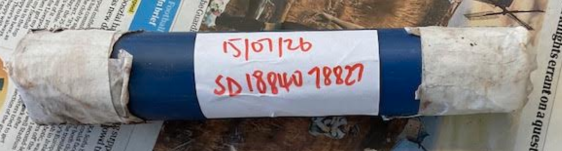
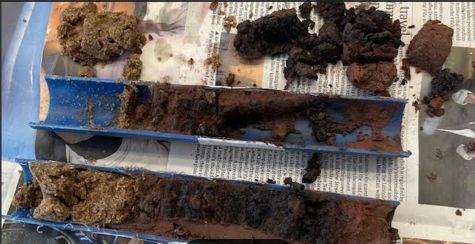 As can be seen, there are three distinct sections of different colour which will probably represent three different time
periods. Stephe went on later to sieve through the mud and found at least six samples of organic matter which suggests
when the large ones taken by Dan have been processed, they will also have organic matter that can be radiocarbon dated.
Building on the training by Dan, on Friday, 31st July, volunteers met Stephe down on the grass at Tornado Wire (thank you
Tornado) where he brought equipment he had used in previous surveys to go over what Dan had shown the group. Stephe is
experienced at archaeological surveying having done several projects with Duddon Valley Local History Group.
Here are a series of photographs taken during the excellent session, at the end of which Stephe, being an ex teacher,
gave the volunteers a test to ensure they had all thoroughly learnt how to plot the footprints. It was a fantastic morning
and huge thanks to Stephe. Tornado training, the last photo shows the plotting
of pretend footprints which volunteers were then able to transfer onto graph paper so that in future we will know exactly
where the footprints have appeared.
We are working out a monitoring programme where some of the volunteers can regularly go down to check if any footprints
appear while a second lot of volunteers (the ones with the technical knowledge) can go down and take photos, measure the area
and draw up plans so that in future anyone will be able to go to the exact spot to see if they are still there.
As can be seen, there are three distinct sections of different colour which will probably represent three different time
periods. Stephe went on later to sieve through the mud and found at least six samples of organic matter which suggests
when the large ones taken by Dan have been processed, they will also have organic matter that can be radiocarbon dated.
Building on the training by Dan, on Friday, 31st July, volunteers met Stephe down on the grass at Tornado Wire (thank you
Tornado) where he brought equipment he had used in previous surveys to go over what Dan had shown the group. Stephe is
experienced at archaeological surveying having done several projects with Duddon Valley Local History Group.
Here are a series of photographs taken during the excellent session, at the end of which Stephe, being an ex teacher,
gave the volunteers a test to ensure they had all thoroughly learnt how to plot the footprints. It was a fantastic morning
and huge thanks to Stephe. Tornado training, the last photo shows the plotting
of pretend footprints which volunteers were then able to transfer onto graph paper so that in future we will know exactly
where the footprints have appeared.
We are working out a monitoring programme where some of the volunteers can regularly go down to check if any footprints
appear while a second lot of volunteers (the ones with the technical knowledge) can go down and take photos, measure the area
and draw up plans so that in future anyone will be able to go to the exact spot to see if they are still there.Please contact us if you would like to get involved: 01229 711654.
TALKS The attached presentation was given at Kirby and Ireleth History Group on Thursday, 21st May. It was extremely well received. The same talk was given at Millom Library on Friday, 5th June, 10 to 12 noon. And we will be giving a talk at the Beacon Museum on 2nd August as part of their Archaeology fortonight. FURTHER INFORMATIONIn September 2022 the History Society held an event, Millom in Prehistoric Times. Duane spoke at the event, here is his powerpoint. Two of the other speakers were Claire Bradshaw of the Morecambe Bay Partnership who spoke about Neolithic and Bronze Age Millom. and Dr. Alison Burns who spoke about Prehistoric Coastal Footprints - Formby and other Sites.
Dr. Burns is now retired but is an expert on ancient footprints, she says Duane's photos are "a fantastic record." Here is a link to Dr Burns giving a talk on Footprints at FormbyAnd here is a link to our Prehistory page in Millom Through Time.
MILLOM AND DISTRICT PREHISTORIC PAST
We have just ordered a third reprint of the above book which will be obtainable from Sutton's Bookshop, Ulverston - 01229 588858 or Millom Heritage and Arts Centre - 01229 772555 or from Holy Trinity Church, Millom.
OTHER, SIMILAR, PROJECTS
Low Hauxley, Northumberland:
Archaeological Research Services
Happisburgh:
St Ouen's Bay, Jersey:
Magor Pill, Gwent and Uskmouth, Newport, South Wales:
Goldcliff, Gwent, South Wales:
The Trust for Welsh Archaeology
Kenfig, Pembrokeshire, Wales:
Splashpoint, Rhyl, North Wales:
Formby Point, Sefton Coast, Merseyside:
Walney Island, Barrow-in-Furness, Cumbria:
There appears to be little information about the footprints on Walney Island. Morecambe Bay Partnership: Dr Alison Burns Talk
Lucan Bay, Angus, Scotland:
In February 2026 Aberdeen University released information and a video about ancient footprints being found in Scotland. Here is a link to a short video about the discovery.